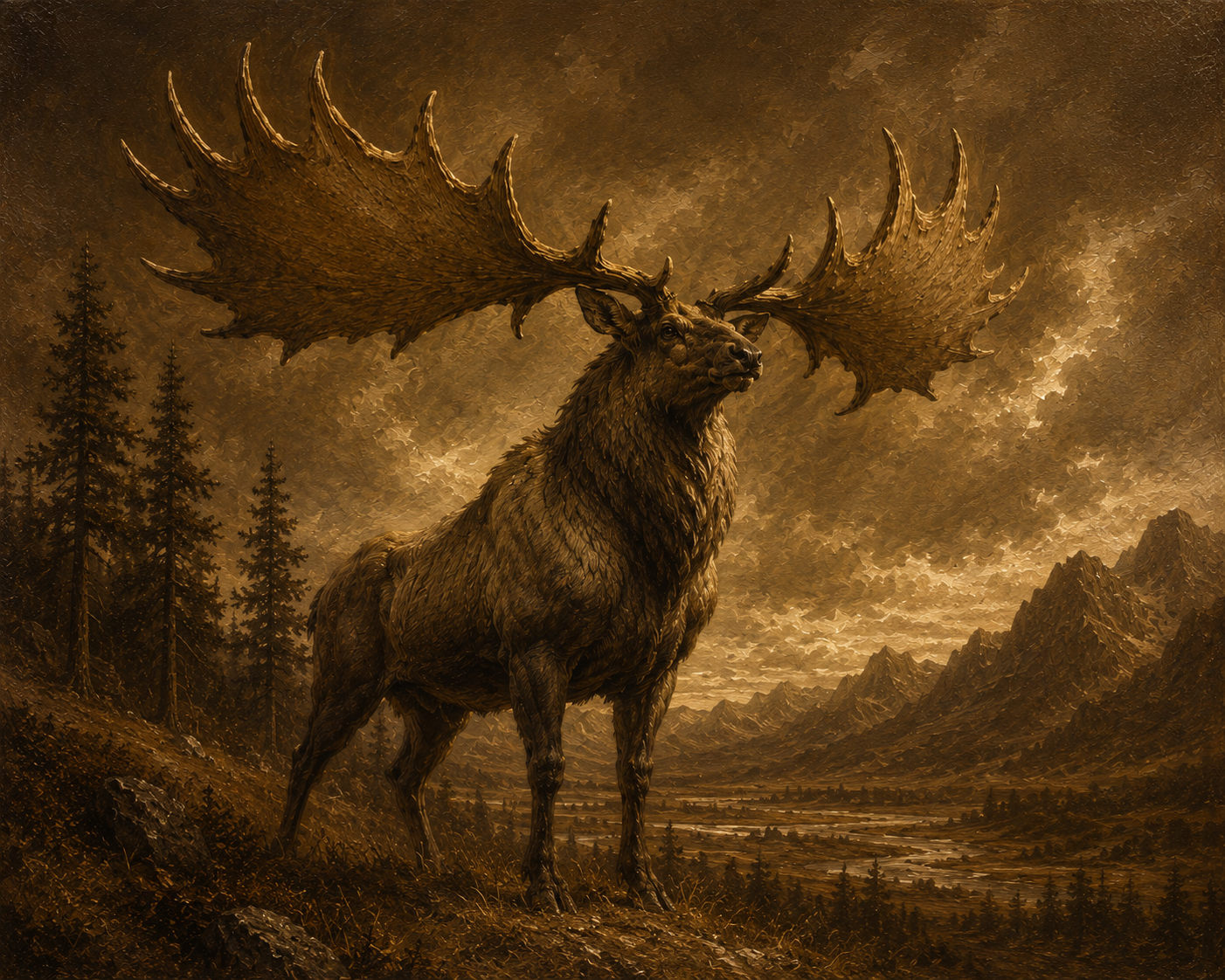
Believed extinct in the Heartlands region. Unverified sighting reports persist from the northern ranges and eastern passes.
Once the dominant megafauna of the Heartlands basin, the cerostim shaped the region’s ecology and drew its first human settlers to the plain. Their absence defines the landscape as much as their presence once did.
Physical Description
The cerostim is a large deer, heavier and taller than its forest-dwelling cousins, built for open ground and forest edge rather than dense cover. The body is heavily muscled beneath a coarse, dark brown coat that lightens along the flanks in winter. The legs are long and capable - a cerostim moving at pace crosses ground with a silence that observers consistently note as wrong for something of its size.
The antlers are the defining feature and occur only in mature bulls. They are palmate rather than branching, broad flat spans of bone with tines projecting from the outer edge, extending up to twelve feet tip to tip. The weight of a full rack approaches eighty to ninety pounds. Bulls carry their antlers with a characteristic high-set posture that keeps the span level and readable from a distance. Cows are antlerless and roughly three quarters the size of bulls.
Wild Behavior
Cerostim are migratory herd animals, historically moving between northern mountain foothills and the southern coast in seasonal cycles. Herds traveled in the hundreds, following established routes across the Heartlands plain that remained consistent across generations. Individual animals are browsers and grazers both, adapting diet to available forage across the migration range.
They are passive toward most animals and humans outside of rut season. A bull in rut is a different animal entirely - territorial, aggressive, and capable of doing serious damage with both antlers and hooves. Hunters are advised to treat a rutting bull as an active threat regardless of provocation.
Stone drakes historically preyed heavily on cerostim during migration, timing their own seasonal activity to the herd movements. The collapse of cerostim populations in the Heartlands correspondingly stressed drake food supplies and altered drake ranging behavior.
Domesticated Behavior & Uses
Cannot be domesticated. Historically the primary large game animal of the Heartlands, providing meat, hide, bone, and antler material. Antler spans were kept as trophies and status markers among hunting cultures.