Culture
The Nirashi do not know where they came from. Their oldest stories begin already in motion - crossing a range, sheltering in a valley, moving on. There is no golden age, no lost homeland, no before. Only the road, as far back as memory reaches. This is not experienced as grief. It is simply the shape of what they are.
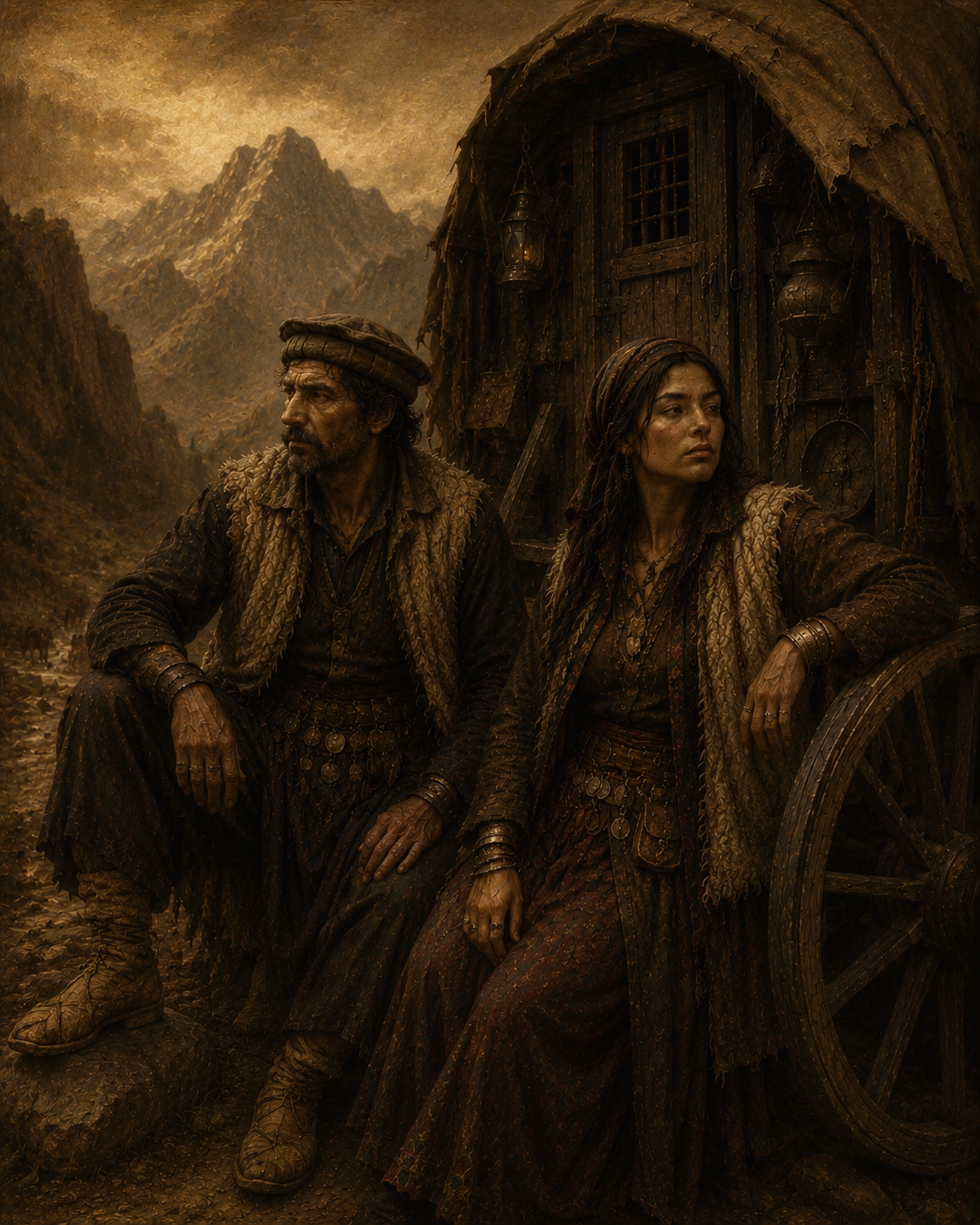
What they carry instead of land is practice - and things. The Nirashi accumulate because they must. Portable wealth is the only kind available to a people who cannot own property, and it shows. A Nirashi caravan announces itself in layered textiles, decorated pack animals, metalwork worn and carried and traded. Jewelry is savings. Ornamentation is security. What a settled person builds into walls, a Nirashi wears on their body or packs onto a cart. The wool and hide they wear comes from the mountains themselves - harvested from wild stock in terrain most people don’t survive long enough to learn. It does not look like anything a settled weaver produces.
It is not meant to.
Their sensitivity to the world’s energies runs toward the informational - patterns, futures, hidden connections between things. This is ingrained into their culture, passed through practice and demonstration across generations, and it expresses most visibly in divination. Cards, bowls, objects worn smooth by use. The tools matter less than the practitioner’s attunement, but the tools matter.
Nirashi groups vary enormously in character. One band might resemble a traveling merchant family. Another operates closer to an independent warband. What holds them together across these differences is not organization but temperament - a particular way of moving through the world that settled people recognize without being able to name.
Politics
There is no central Nirashi leadership and no unified Nirashi position on anything. Each group organizes itself, with authority falling to whoever has demonstrated the most useful combination of wisdom, competence, and survival. Elder women hold disproportionate influence in most groups, though this varies.
The Nirashi relationship to Imperial law is philosophical rather than rebellious. The Empire requires taxes, stability, and freedom of Legion movement - and concerns itself with nothing else. Everything beyond that is left to Domain Lords and local custom. The Nirashi, who pay no taxes and hold no land to impede Legion mobility, sit outside that framework entirely. They do not break the Empire’s law because the Empire’s law does not reach them. What Domain Lords think about this is the Domain Lord’s problem.
How settled communities regard the Nirashi varies by region and by who benefits from the current arrangement. Where established trade infrastructure serves local interests, the Nirashi are viewed with suspicion - disruptive, untrustworthy, outside the social contract. Where that infrastructure fails or where the Domain Lord’s interests diverge from those of the people beneath him, the Nirashi are viewed as the only honest brokers in the region. The difference in perception tells you more about local politics than about the Nirashi themselves.
Economy
The Nirashi trade in things that travel well and require no fixed location. Crafted goods, medicinal preparations, divination services, information, and the movement of goods that settled traders cannot or will not handle. Their attunement to the world’s patterns makes them reliable readers of futures and routes - a Nirashi who says a pass will be dangerous next week has usually been right before.
Among their most distinctive trade goods are the products of mountain hunting. The Nirashi hunt the wild sheep of the upper ranges - sure-footed animals that descend into the valleys in winter and retreat above the treeline when the weather breaks. The hide and wool taken from these animals is unlike anything produced from domestic stock: coarser, denser, weatherproof in ways that farmed wool is not. The horn is worked into tools, vessels, and bow reinforcement. The meat, slow-cooked with high-elevation herbs gathered along the same routes, produces a dish with a flavor that settled cooks cannot replicate - not because the recipe is secret, but because the ingredients don’t exist below a certain altitude.
They share those hunting grounds with wolves, bears, and whatever else moves through the mountain terrain. This is not considered remarkable by the Nirashi. It is considered the cost of knowing where to go.
The gray legality of their operations is not an accident or a moral compromise. It is a correct reading of the law. The Empire does not prohibit what they do. Domain Lords may object, but Domain Lords are not the Empire. The Nirashi understand the distinction more clearly than most of the people who resent them for it.
They are not wealthy by Imperial measure. They are also not dependent on Imperial systems to survive, which is a different kind of security - one that no amount of taxation or political pressure has yet managed to remove.