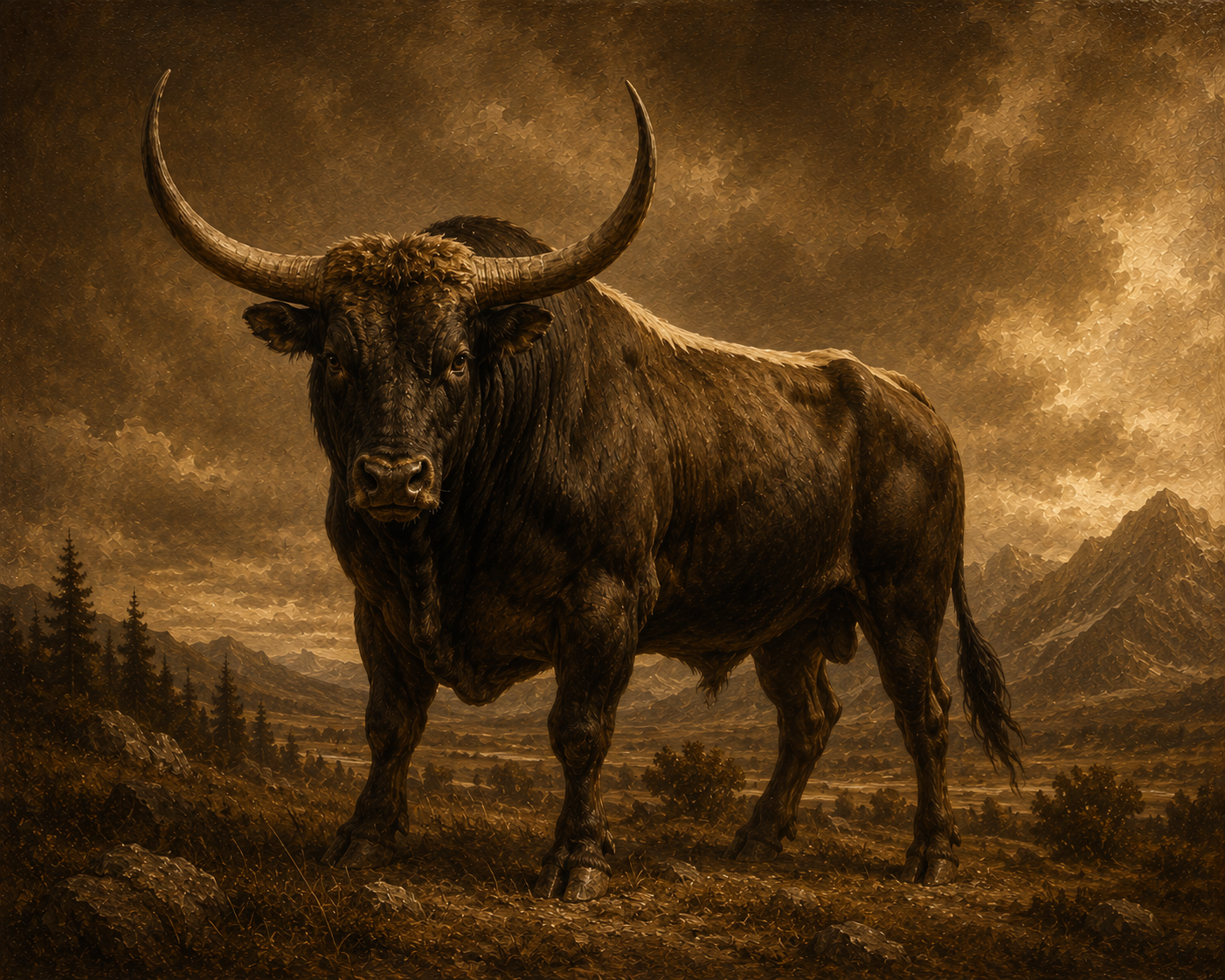
Excerpt from Capricen – a book of recipes archivists dated to the mid-6th century.
Ah the wild cow, how lean the meat, yet delicious. Many confuse them for our domesticated cattle, and for good reason – they are the same animal. Some farms still rely on them, and some prefer them as ox. For while the domestic cattle has been bred to become fat, the auroch remains muscular. This makes it particularly good for preserving as the meat takes salt much better, and conditions faster.
Yet it is not an easy animal to harvest. They are quite massive, significantly larger than other cattle breeds. The body is deep-chested and heavily muscled, carried on legs built for rough terrain. Their coats range from dark brown to near black in bulls, lighter in cows, often with a pale stripe running the length of the spine. The bulls are especially intimidating, with horns swept forward and upward from the skull in a wide arc, as long as a man’s arm or more. They carry their heads lower than domestic cattle, with a broad forehead and a directness to the gaze that unsettle many hunters, and for good reason.
In the wild, the auroch are grazers and browsers that occupy the edges of the forests, river valleys, and, rarely, the open plains across the Heartlands basin. They travel in herds that are typically small – a dominant bull, several cows, and calves – with younger bulls moving in loose bachelor groups at the margins. They are not migratory in the same manner as other animals might be, but tend to move seasonally across established ranges following forage and water. An auroch bull near the edge of the woods is a sight, especially when it is covered in a blanket of snow.
Generally, they display a passivity toward people and even smaller predators at a distance. If one dares to move too close, the auroch is an entirely different encounter. Bulls charge without warning when threatened, and have been known to seriously injure and even kill horses with their large horns. Taking down a mature bull is a significant undertaking, even for the largest predators in the region.
Domestic cattle in the Heartlands are descended from aurochs stock, and retain more of the wild type’s size and temperament than breeds in other regions. This means a poor farmer may be able to boost their stock by capturing wild aurochs, bull or otherwise, but the practice is extremely dangerous. Wild bulls have been known to infiltrate domestic herds on their own, often killing any existing bulls before mating with the females. Calves taken young and raised in human company are manageable.
On farms, they are used for meat, milk, hide, and, as mentioned earlier, draft labor as oxen. Farm-raised auroch lack the flavor of their wild kin, and discriminating cooks can taste the difference immediately.