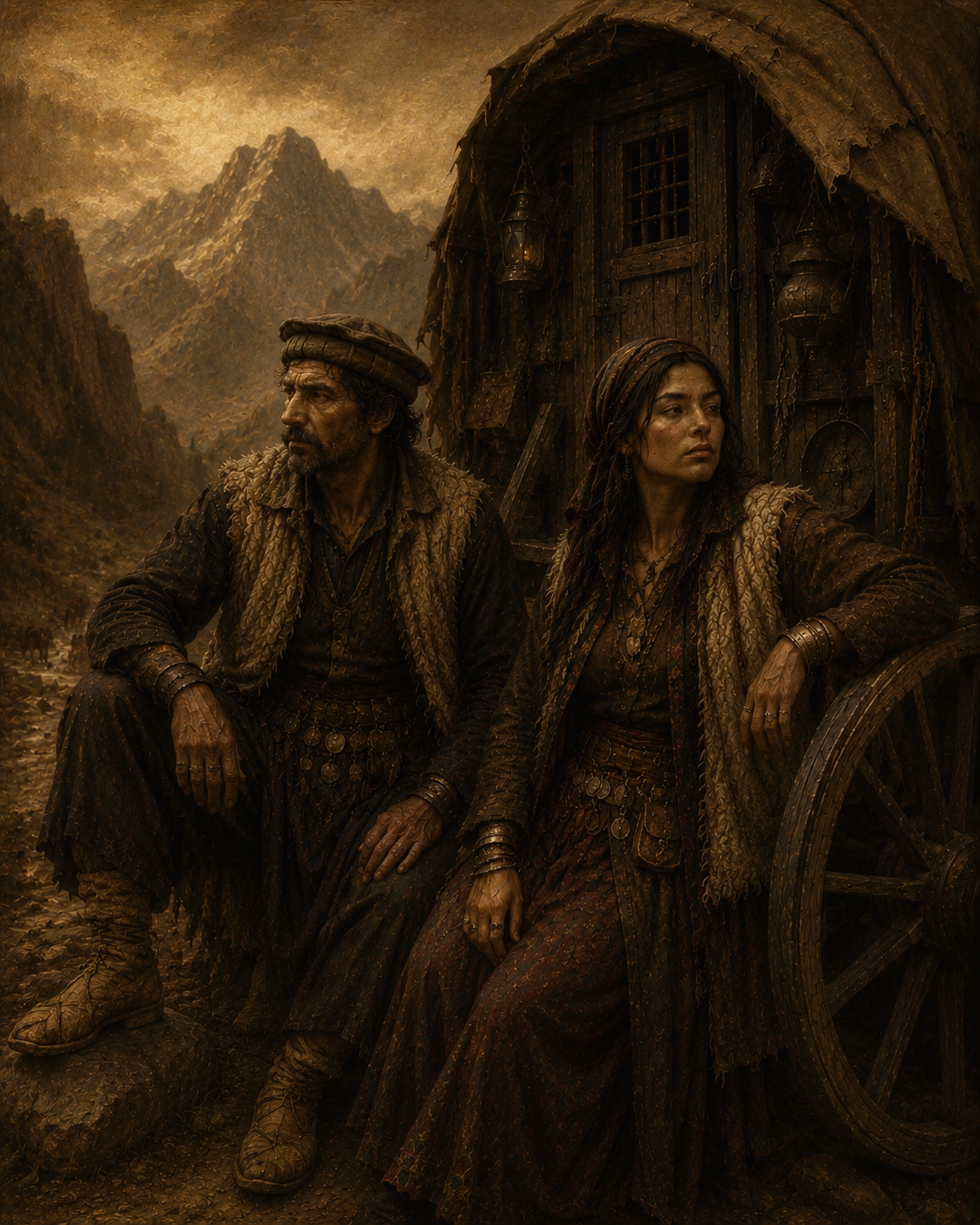
Document found on a corpse under a low stone in the mountains near Blackwood. It was discovered after local residents gathered to drive away a small black bear that had been harassing the village. The document was provided to local guards who advised the Domain Lord of the discovery. It was then confiscated by the Prefect and entered into the Imperial Archives in Timbur Deep, Year 717 CR.
The Nira People
I have learned much about the Nirashi since joining them some weeks ago in Moonglade. I have learned that, even among themselves, they are a mystery.
The Nirashi do not know where they come from. Their oldest stories begin with motion – crossing a range, sheltering in a valley, moving on. They do not have a homeland, no record of what came before, no golden age. Most would experience this as a type of grief, a lack of belonging. To the Nira people, it is simply the shape of who they are.
It follows, then, that the Nirashi accumulate things because they must. Portable wealth is the only kind available to a people who own no property, and it shows in how they travel. Layered textiles, decorated pack animals, and metalwork announce a Nirashi caravan at a distance. Jewelry and ornamentation become security, a currency that can be worn and traded. What a settled people build into walls, a Nirashi wears on their body, or embed into their covered cart-homes.
They are a resourceful people, I have learned. They harvest wool and hide from wild stock in the mountains, deep in terrain most people don’t survive long enough to learn. The wool especially carries a quality unlike anything a settled weaver produces, and is renowned for its durability. They drive their caravans up to places where the trees meet the clouds, then continue on foot high above. They return with their spoils before nightfall, and everything is shared within the clan.
But the Nirashi are adept at more than just the hunt. I have witnessed their connection to the world’s energies in wonder. To say that they are fortune tellers would be inaccurate, and is a myth held primarily by those who do not know them. Rather, they see shapes. The shape of things that were, and things that are. One of their elders told me that this is what allows them to clear the fog of the future, like a sculptor chipping away the stone to reveal a statue. It’s not that they know how to make dreams come true, despite what some might believe.
They were the first to use objects to channel mana. Another claim they’ve laid before me, though this I would remain skeptical of. It is, however, a practice so ingrained into their culture that the tools have become highly associated with their people, and the art of divination. Reflective bowls, thick paper cards with elaborate drawings, smooth bones cast on the floor… It’s understandable that some mistake them for wildkin or shaman.
Nirashi groups vary enormously in character. One may resemble a traveling merchant family, another a group of entertainers. Some focus on the hunt, and even offer services as mercenaries, if they don’t run off with your coin. What connects them is an uneasy comfort with impermanence, something most settled people recognize without being able to name directly.
Nirashi Politics
A very interesting fact I have learned about them is they are both independent, and not independent clans at the same time. Each group organizes itself, often gifting authority to whoever has demonstrated the most useful combination of wisdom, competence, and survival. Elder women hold a disproportionate influence in most groups, though this varies. Within this independence, there is still a sense of belonging between one group and the next. I have witnessed this personally on several occasions when the caravans have run across each other. They trade while enjoying food and drink, and even sing songs they all seem to know, even if it was their first time crossing paths.
Their relationship to Imperial law requires an interpretation of philosophy. The Empire requires taxes, stability, and freedom of Legion movement, concerning itself with almost nothing else. Laws and policies beyond that are left to the Domain Lords and local custom. The Nirashi hold no land to impede the Legion, and pay no taxes. Therefore, they sit outside of that framework entirely. They do not break the Empire’s law because the Empire’s law does not reach them. What the Domain Lords think about this is the Domain Lord’s problem.
How the Domains view the Nirashi varies by region and by who benefits from their presence. Where Merchant Houses dominate trade and local interests, they are viewed with suspicion. Even when they haven’t proven themselves to be disruptive or untrustworthy, the simple fact that they live outside the social contract presents problems. A Domain Lord cannot simply send their guards to deal with a Nirashi caravan the same way they could with a defiant farmer because the Nirashi caravan may not exist by the time the guards arrive. Once wealth becomes mobile, it becomes nearly impossible to tax reliably.
In other regions, the Nirashi may be of great assistance to the local Domain Lord and earn their favor. Whether relying on their ability to bring in valuable supplies or use their divination skills to root out enemies, the Nirashi have made themselves invaluable in places where conventional services fail.
Nirashi Traders
The Nirashi trade in things that travel well and require no fixed location. Crafted goods, medicinal preparations, divination services, information, and the movement of goods that settled traders cannot or will not handle. Their attunement to the world’s patterns makes them reliable readers of futures and routes - a Nirashi who says a pass will be dangerous next week has usually been right before.
Among their most distinctive trade goods are the products of mountain hunting. The Nirashi hunt the wild sheep of the upper ranges - sure-footed animals that descend into the valleys in winter and retreat above the treeline when the weather breaks. The hide and wool taken from these animals is unlike anything produced from domestic stock: coarser, denser, weatherproof in ways that farmed wool is not. The horn is worked into tools, vessels, and bow reinforcement. The meat, slow-cooked with high-elevation herbs gathered along the same routes, produces a meal with a flavor that settled cooks cannot replicate - not because the recipe is secret, but because the ingredients don’t exist below a certain altitude.
The Nirashi are expert smugglers, and many, including Merchant Houses and Domain Lords, take adv…
They are not wealthy by Imperial measure. They are also not dependent on Imperial systems to survive, which is a different kind of security - one that no amount of taxation or political pressure has yet managed to remove.